
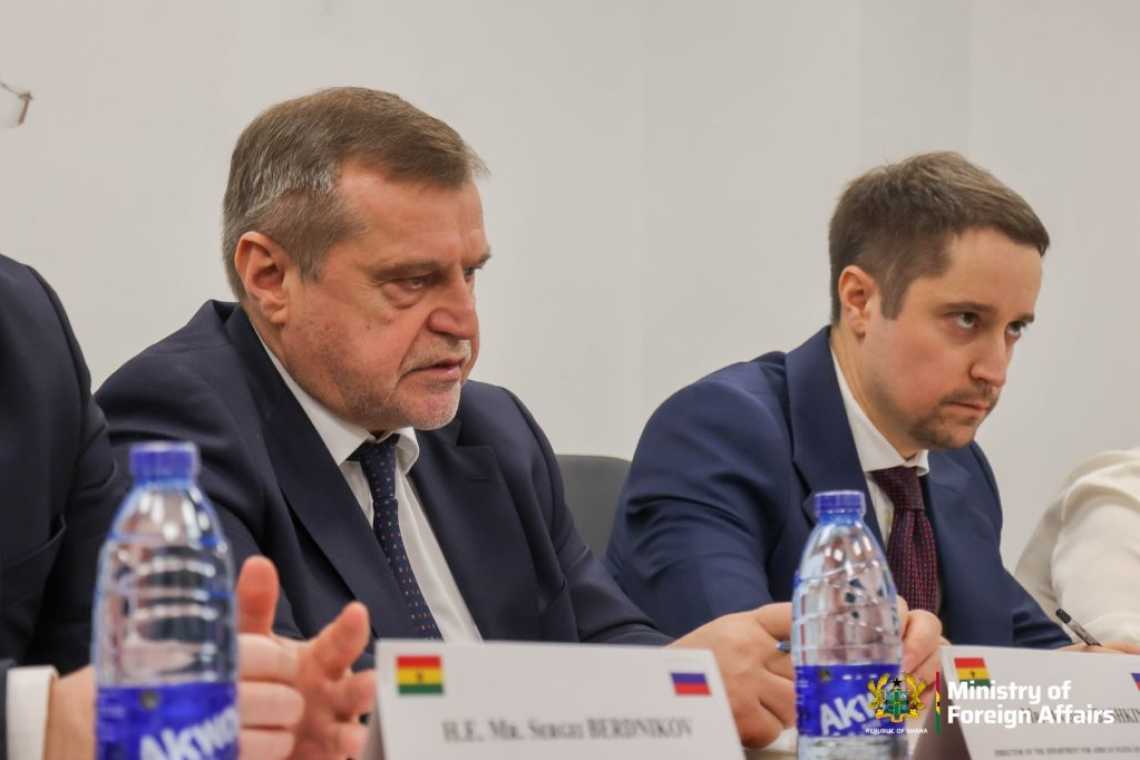
In a significant diplomatic session held on March 12, 2026, officials from Ghana and the Russian Federation convened at the Ministry of Foreign Affairs in Accra to undertake a
comprehensive review of their bilateral partnership. The technical session, led by senior diplomats from both nations, aimed to modernize a relationship that spans nearly seven decades, focusing on industrial growth, technology transfer, and sensitive security concerns.
The meeting comes at a pivotal time as both nations prepare for the Third Russia–Africa Summit, slated for October 2026.
1. The Five Pillars of Cooperation
The consultations moved beyond traditional diplomacy to focus on "practical deliverables" designed to support Ghana's industrialization agenda.
-
Agriculture & Industry: Discussions centered on manufacturing and industrial development to bolster food security.
-
Infrastructure & Energy: Exploring Russian technical expertise in large-scale energy projects and physical infrastructure.
-
Technology Transfer: A commitment to moving from a "buyer-seller" relationship to one focused on sharing technical know-how.
-
Education & Vocational Training: Expanding university partnerships in Medicine, Engineering, and Science, alongside a new focus on Technical and Vocational Education and Training (TVET).
-
Capacity Building: Specialized training for Ghanaian professionals across various technical sectors.
2. Security and Legal Challenges: Addressing the "Friction Points"
While the tone of the meeting was collaborative, the Ghanaian delegation raised two critical and sensitive issues that required immediate bilateral cooperation.
| Issue | Ghana’s Position | Agreement Reached |
| Cybercrime/Privacy | Request for accountability regarding a Russian citizen allegedly publishing explicit images of Ghanaian women without consent. | Russia agreed to cooperate in holding the individual accountable under international legal frameworks. |
| Military Enlistment | Concerns over the reported enlistment of Ghanaian youth in Russia’s "special operations." | Both parties agreed to a joint working mechanism to address and resolve the matter. |
3. Regional Stability and the "Sahel Reset"
The delegations exchanged views on the deteriorating security situation in the Sahel region. With Ghana playing a leading role in ECOWAS and Russia increasing its footprint in West Africa, both sides emphasized the need for political dialogue to restore regional stability.
Mr. Harold Adlai Agyeman, Coordinating Director of Political and Economic Affairs, noted that the 68-year partnership is grounded in "mutual respect and solidarity," which provides the necessary foundation to navigate these complex regional dynamics.
4. Roadmap to the 2026 Russia-Africa Summit
The Accra session served as a "pre-summit" briefing. Anatoly Bashkin, Director of the Department of African States of the Russian Federation, and Eric Owusu-Boaten, Director of the Europe Bureau, reaffirmed their commitment to finalizing outstanding bilateral agreements before the October summit.
The Bottom Line
The 2026 Ghana-Russia consultations represent a "Diplomatic Reset" aimed at balancing longstanding historical ties with the urgent security and economic needs of the modern era. By addressing sensitive issues like youth enlistment and digital privacy alongside trade, both nations are attempting to build a more transparent and resilient partnership.