
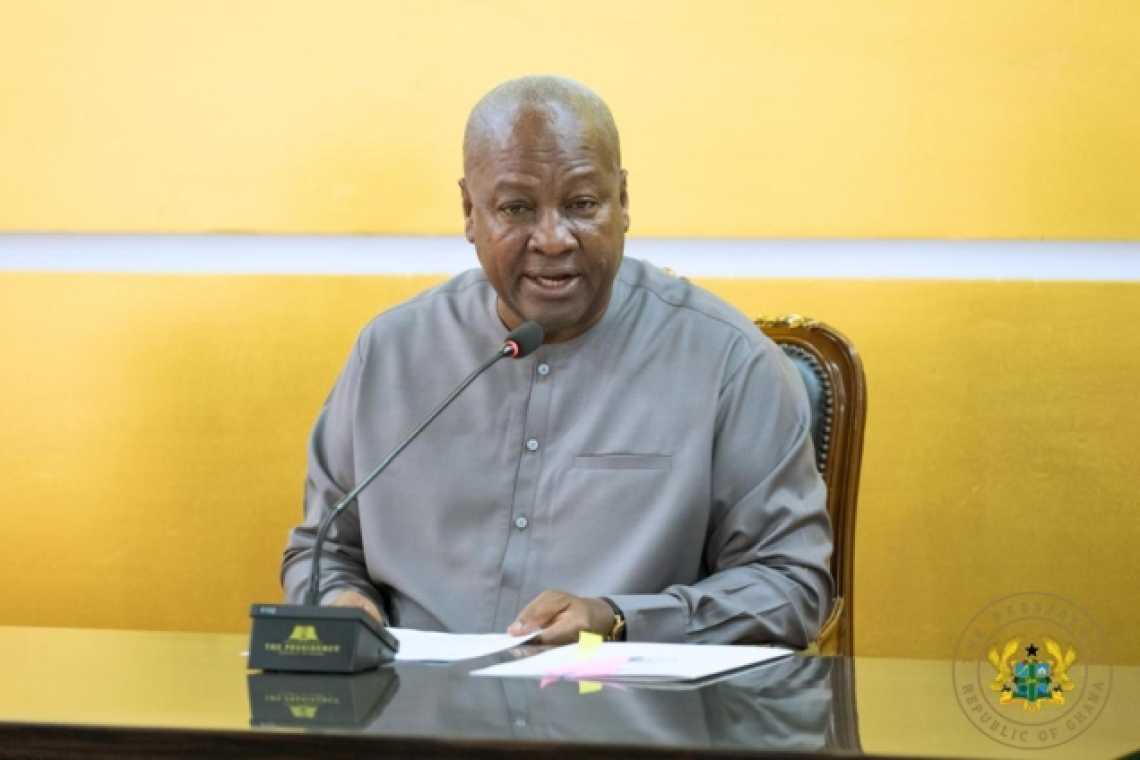
In a high-stakes meeting with organized labor at the Jubilee House on Tuesday, President John Dramani Mahama moved to de-escalate tensions over the future of the Electricity
Company of Ghana (ECG). The President presented a strategic "institutional architecture" designed to fix the utility's chronic revenue leakages through private sector participation—while issuing a "no-job-loss" guarantee to workers.
The dialogue also pivoted to a critical "Pension Reset," with the President warning that the current imbalance between contributors and retirees threatens the dignity of future senior citizens.
1. The ECG Reform: "Partnership, Not Privatization"
President Mahama was emphatic that the government is not selling off ECG. Instead, it is bringing in private expertise to handle the company's two "weakest links": billing and metering.
-
The Mechanism: ECG will remain a state-owned entity. It will sell bulk electricity to private providers who will then be responsible for accurate collection and metering.
-
The Financial Goal: By fixing "billing inefficiencies," the government aims to stabilize ECG’s cash flow, which in turn will fund better wages and working conditions for its staff.
-
The Debt Burden: The President revealed that US$1.57 billion was spent settling energy sector legacy debts in 2025 alone, with a total of US$8 billion spent over the last nine years to keep the lights on.
2. The Pension Crisis: A 7% GDP Warning
The President raised the alarm over Ghana's low pension coverage, noting that pension assets currently stand at GH¢100 billion. While this sounds substantial, it represents only 7% of Ghana’s GDP—far below continental benchmarks.
The Pension Gap (2026 Data): | Category | Statistic | | :--- | :--- | | Total Workforce | ~10 Million | | Active Pension Contributors | Less than 2 Million | | The Risk | A deepening imbalance that could lead to the collapse of the system for future retirees. |
3. The "MahamaCare" Pension Roadmap
To address these "threats to dignity," the Ministry of Finance has been tasked with a complete overhaul of the pension structure.
-
Informal Sector Expansion: New incentives to bring the 8 million "missing" workers (traders, farmers, artisans) into the pension net.
-
Modernized Contributions: Moving toward a transparent, digital-first contribution system to eliminate "lost" records.
-
Governance Strengthening: Enhanced management of investment portfolios to ensure pension funds grow faster than inflation.
4. A Unified Vision for Labour
President Mahama concluded by framing these reforms as a collaborative effort rather than a top-down directive. "This reform is not designed against labour," he stressed, "it is designed with labour and for the long-term stability of Ghana’s public sector."
The Bottom Line
The Tuesday briefing represents a "Stability Reset" for 2026. By tackling the energy sector's financial leaks and the pension system's low coverage simultaneously, the government is attempting to build a "remuneration system that is transparent and equitable." For the worker at ECG or the trader in Makola, the message is the same: the goal is security in active service and dignity in retirement.