
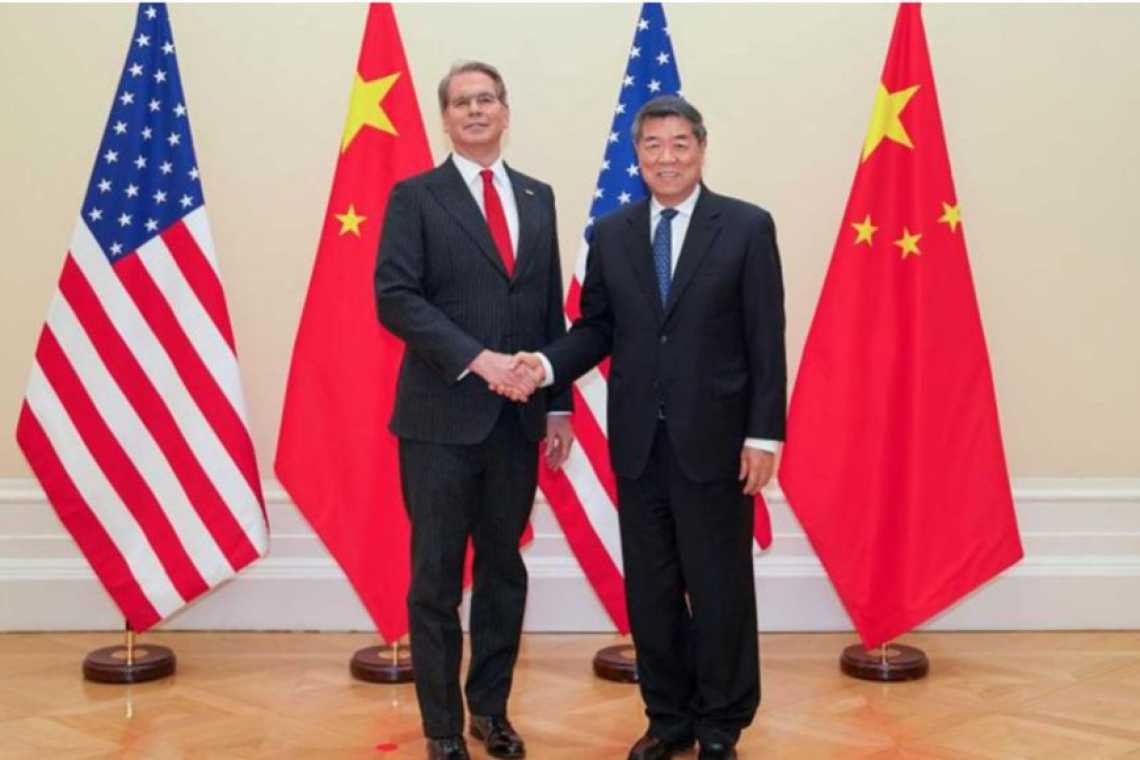
In a high-stakes diplomatic marathon held from Sunday to Monday, the economic leadership of the world’s two largest powers concluded "candid and constructive" consultations aimed at stabilizing a global economy rocked by recent legal and regulatory shifts.
Led by Chinese Vice Premier He Lifeng, U.S. Treasury Secretary Scott Bessent, and U.S. Trade Representative Jamieson Greer, the delegations moved to navigate a complex landscape of Supreme Court rulings and new surcharges that have injected fresh uncertainty into trans-Pacific trade.
1. Navigating the "Legal Storm": SCOTUS and Section 122
The talks occurred against a backdrop of significant legal upheaval in the United States. Vice Premier He Lifeng pointedly referenced a recent U.S. Supreme Court ruling that declared certain tariffs imposed under the International Emergency Economic Powers Act (IEEPA) to be unlawful.
The Current Tariff Landscape:
-
The Surcharge: Following the court ruling, the U.S. implemented a 10% import surcharge on all trading partners under Section 122 of the Trade Act of 1974.
-
China-Specific Measures: The U.S. has continued to move forward with Section 301 investigations, corporate sanctions, and targeted market access restrictions.
-
The "Zero-Tariff" Demand: China reiterated its consistent opposition to unilateral tariffs, urging Washington to "completely remove" restrictive measures to ensure a healthy trade relationship.
2. Reaching New Consensus: Stability as a Priority
Despite the friction, both delegations emphasized that a stable China-U.S. relationship is the bedrock of global supply chain security and financial stability.
Key Outcomes of the March 2026 Round:
| Area of Agreement | Strategic Goal |
| :--- | :--- |
| New Cooperation Mechanism | To be studied and established specifically to promote bilateral trade and investment. |
| Consultation Continuity | Commitment to making "good use" of existing economic and trade consultation mechanisms. |
| Risk Management | Agreement to "properly manage differences" and avoid further escalation of trade frictions. |
| Outcome Integration | Building on five previous rounds of consultations to inject "certainty" into the global market. |
3. Strategic Guidance: The "He-Bessent" Dialogue
The talks were guided by the strategic common understandings reached between the two heads of state. Secretary Scott Bessent noted that reducing frictions is not just a bilateral necessity but a global imperative to promote economic growth.
-
U.S. Perspective: Focused on resolving differences through consultation rather than escalation, emphasizing the security of international supply chains.
-
Chinese Perspective: Urged the U.S. to "move in the same direction," expand areas of cooperation, and reduce the "problems" created by negative measures and market restrictions.
4. Protecting Rights and Interests
Vice Premier He Lifeng was firm in stating that China would take "necessary steps" to safeguard its legitimate rights. This suggests that while China is committed to dialogue, it remains prepared to respond to what it views as unlawful unilateralism. The goal remains a "sustained, stable, and sound" development of bilateral relations that can withstand the pressures of domestic policy shifts.
The Bottom Line
The March 2026 talks represent a "Diplomatic Reset" in the face of judicial intervention. By agreeing to study new cooperation mechanisms while the U.S. navigates its own internal legal constraints on tariff powers, both nations are attempting to build a "firewall" around global trade. The next few months will determine if the "10% surcharge" becomes a permanent fixture or a temporary bargaining chip in this ongoing economic chess match.