
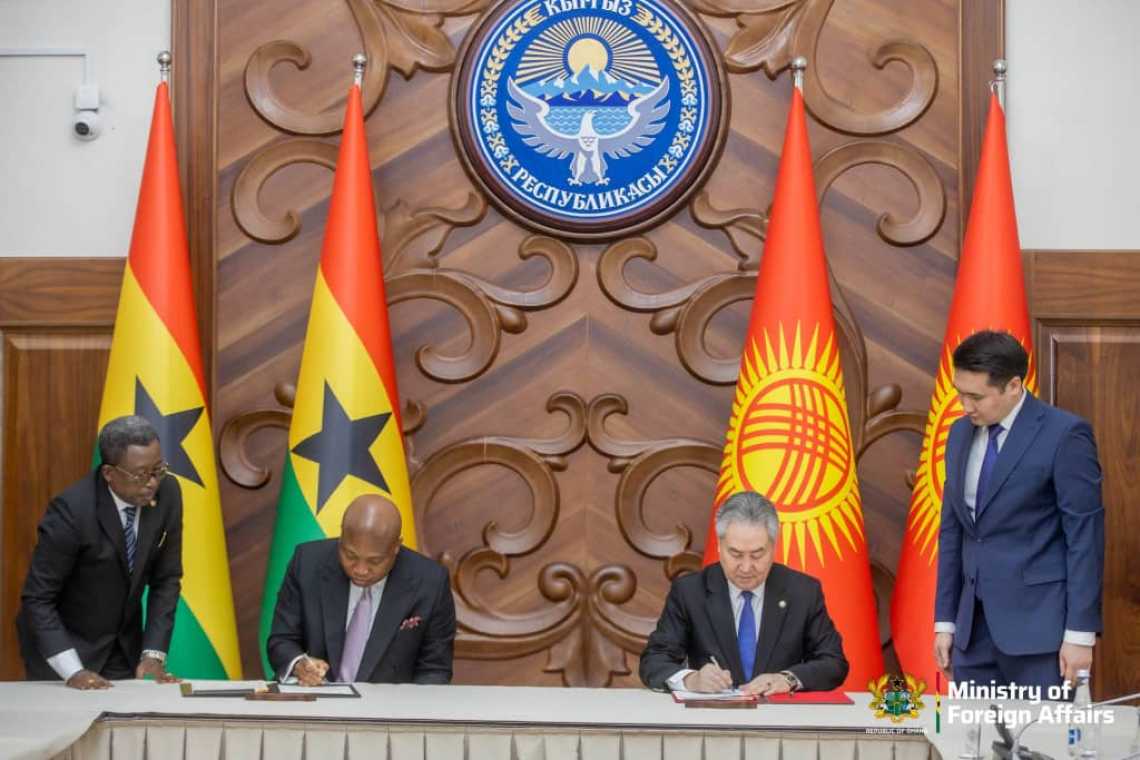
In a move that redefines Ghana’s "Global South" strategy, the Minister of Foreign Affairs, Mr. Samuel Okudzeto Ablakwa, has concluded a historic official visit to Kyrgyzstan. This
marks the first time a Foreign Minister from the African continent has been formally hosted by the Central Asian nation, signaling a bold expansion of Ghana's diplomatic and economic footprint.
The visit to the capital, Bishkek, resulted in the signing of two major bilateral agreements aimed at institutionalizing a partnership centered on mining expertise and seamless diplomatic travel.
1. The "Gold Standard" Partnership
The centerpiece of the discussions between Mr. Ablakwa and Kyrgyz Foreign Minister Jeenbek Kulubayev was the synergy between two of the world's significant gold producers.
-
Ghana’s Role: As Africa’s leading gold producer, Ghana brings centuries of regulatory and operational experience.
-
Kyrgyzstan’s Role: Home to the Kumtor Gold Mine, one of the highest and largest gold operations in Central Asia.
-
The Strategy: A formal mechanism for "Expertise Sharing," allowing both nations to exchange technical data on deep-level mining, environmental reclamation, and mineral revenue management.
2. Breaking Borders: Visa Waivers and Consultations
To facilitate this new era of cooperation, two foundational legal frameworks were signed during the visit:
| Agreement | Impact |
| Visa Waiver Protocol | Immediate free entry for holders of Diplomatic and Service Passports. (Ordinary passport waivers are currently under negotiation). |
| Political Consultation Mechanism | Establishment of a permanent dialogue channel between the two Foreign Ministries to coordinate on international issues and trade. |
3. Why Kyrgyzstan? The Strategic "Observer" Move
Mr. Ablakwa noted that Kyrgyzstan’s recent status as an observer to the African Union makes it a logical gateway for Ghana into the Central Asian market.
-
Diversified Markets: Kyrgyzstan offers Ghana a strategic entry point into the Eurasian economic space.
-
Economic Performance: Kyrgyzstan’s recent GDP growth and mining reforms mirror Ghana’s own industrialization goals, making them "natural peers" in the developing world.
4. South-South Cooperation in Action
The meeting with President Sadyr Japarov underscored a mutual desire to look beyond "traditional allies" (Western and East Asian powers) to find growth opportunities within the Global South.
The two nations have already committed to a roadmap for 2026, which includes:
-
Joint Trade Missions: Connecting Ghanaian cocoa and cashew exporters with Central Asian distributors.
-
Mining Initiatives: Exchange programs for engineers between the University of Mines and Technology (UMaT) in Tarkwa and Kyrgyz technical universities.
-
People-to-People Exchanges: Cultural and educational programs to bridge the geographic gap.
The Bottom Line
The "Bishkek Breakthrough" is a clear signal that Ghana’s 2026 foreign policy is about diversification. By linking the "Gold Coast" of Africa with the "Gold Peaks" of Central Asia, Mr. Ablakwa is positioning Ghana as a pioneer in a new trans-continental economic corridor. As the Minister noted, this visit was not just about protocol; it was about "unlocking new opportunities" for the next decade of growth.