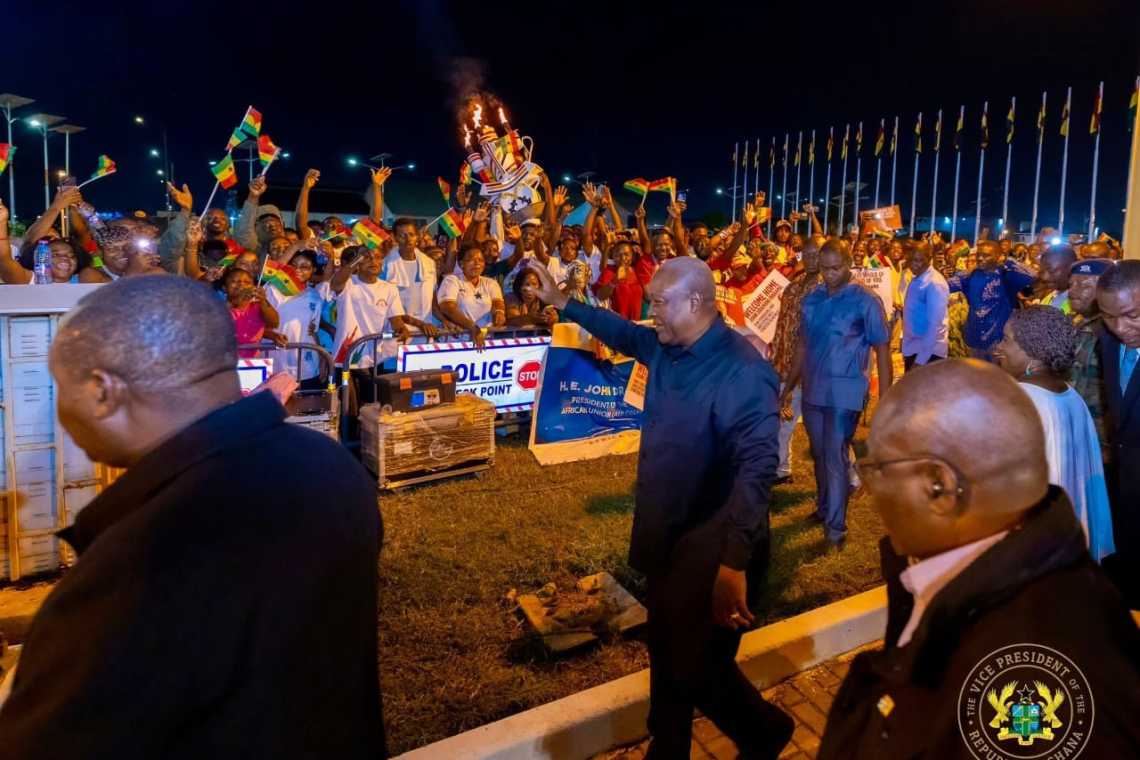
President John Dramani Mahama touched down at Kotoka International Airport on Sunday to a hero's welcome, bringing with him a diplomatic victory that has been decades in the making. Following an intense session at the United Nations General Assembly (UNGA) in New York, Ghana successfully secured the adoption of Resolution A/80/L.48, which
formally classifies the transatlantic slave trade as the "gravest crime against humanity."
The President was received by Vice President Professor Jane Naana Opoku-Agyemang and a jubilant cross-section of Ghanaians, marking a pivotal moment in the "2026 National Reset" focused on heritage, justice, and global leadership.
1. The UN Vote: A 123-Nation Coalition
The resolution, tabled by President Mahama in his dual role as the African Union (AU) Champion for Reparations, faced a complex diplomatic landscape. While it achieved a commanding majority, the voting pattern highlighted lingering geopolitical divisions over the issue of reparatory justice.
The UNGA Scorecard:
-
In Favor (123): A broad coalition including the AU, CARICOM, and countries acting out of "conscience."
-
Against (3): The United States, Israel, and Argentina.
-
Abstentions (52): Including Great Britain and the European Union member states.
2. From "Fragmented Efforts" to Global Record
Addressing the gathering upon his arrival, President Mahama emphasized that while the horrors of the slave trade (which saw 12 to 15 million Africans forcibly removed) have been acknowledged before, this resolution provides the first unified, high-level legal classification.
Key Achievements of the Resolution:
-
Legal Precision: Elevates the trade from a "tragedy" to the "gravest crime against humanity."
-
Reparative Roadmap: Sets the stage for advancing the CARICOM 10-point plan on reparative justice, covering debt cancellation, technology transfer, and psychological healing.
-
Historical Redress: Formally acknowledges the role of coastal enclaves like Elmina and Cape Coast as transit points that caused enduring economic distortions.
3. The "Legwork" Behind the Victory
The President was quick to share the credit, praising the "shuttle diplomacy" of his team. He specifically acknowledged Mr. Samuel Okudzeto Ablakwa, the Minister of Foreign Affairs, for traveling thousands of kilometers to canvas international support.
The Diplomatic Honor Roll:
-
Samuel Okudzeto Ablakwa: Lead mobilizer for international support.
-
Samuel Yao Kumah: Ghana’s Ambassador to the UN.
-
Victor Smith: Ghana’s Ambassador to the United States.
-
CARICOM Partners: For providing the structural framework for reparative dialogue.
4. Context: A Weekend of Institutional "Resets"
The President’s return coincides with a series of major domestic milestones concluded during his absence:
-
Legal: Parliament passed the Legal Education Reform Bill, ending the Ghana School of Law monopoly.
-
Finance: GCB Bank reported a record GH₵3.17B profit by pivoting to commercial banking.
-
Sports: The launch of the "16 by 16" World Cup viewing centers and the $30M Black Stars fundraiser (*899#).
-
Oversight: The OSP being petitioned to investigate "Big Push" road contracts in Sefwi Akontombra.
The Bottom Line
The adoption of Resolution A/80/L.48 represents a "Global Moral Reset." By securing this position at the UN, Ghana has positioned itself as the vanguard of the African Diaspora's quest for justice. As Vice President Opoku-Agyemang noted while welcoming the President—who also received the International Statesperson Award in Philadelphia—this victory is about "truth and dignity." For Ghana, the focus now shifts from symbolic recognition to the "concrete outcomes" of reparative justice.