
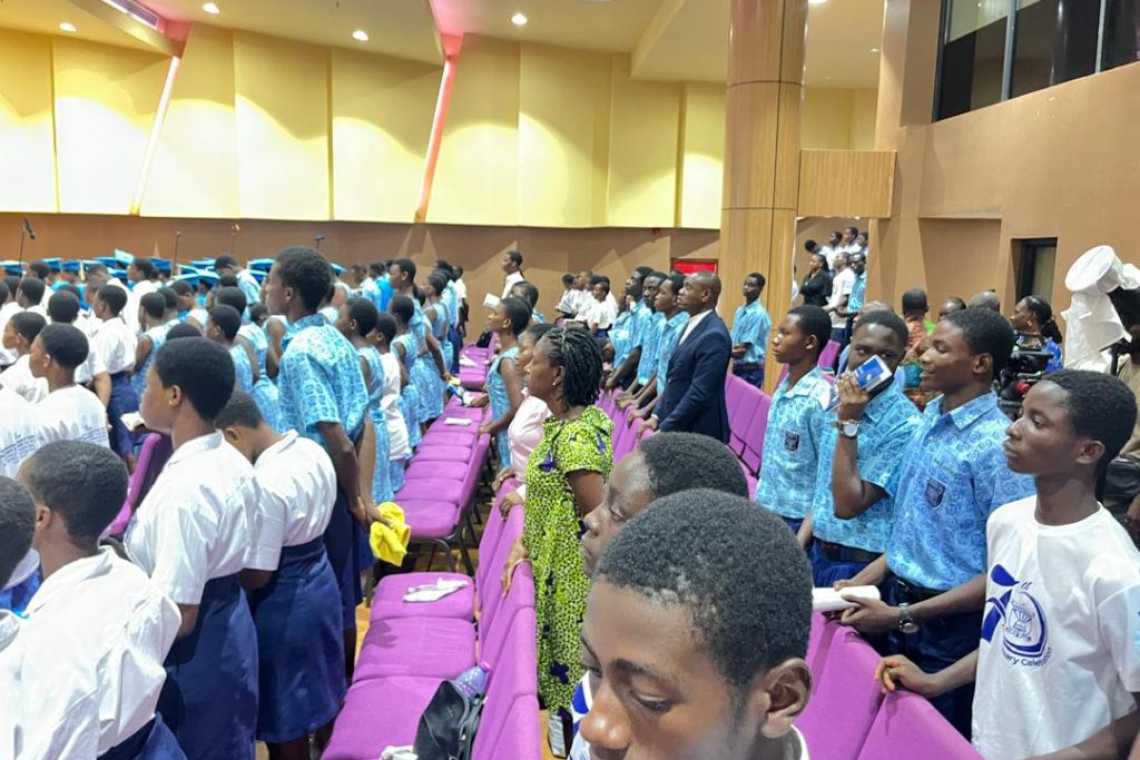
In a powerful call to modernize the nation's human capital, Professor Rosemond Boohene, former Pro Vice-Chancellor of the University of Cape Coast, has urged a fundamental shift
in Ghana's educational curriculum. Speaking at the 70th Anniversary Lecture of Wesley Grammar Senior High School in Accra, Prof. Boohene argued that the current system—a relic of the Industrial Revolution—must be "reset" to produce innovators rather than passive consumers of knowledge.
The lecture, titled "Educated to Innovate: Artificial Intelligence, Entrepreneurship, and the Future of Work," brought together academic leaders to discuss how Ghana can navigate the rapid integration of Artificial Intelligence (AI) into the global economy.
1. From a Knowledge Economy to an Innovation Economy
Prof. Boohene emphasized that the value of an education in 2026 is no longer measured by what a student knows, but by what they can do with that knowledge.
-
The Shift: Moving away from rote memorization toward a curriculum that stimulates "out-of-the-box" thinking.
-
Problem-Solving: Developing learners into "agents of transformation" who see societal challenges as opportunities for innovation.
-
Real-time Adaptation: Recognizing that modern value is created through constant negotiation and the ability to adapt to new technologies.
2. AI: The Partner, Not the Replacement
Addressing the widespread fear that automation will lead to mass unemployment, Prof. Boohene clarified that AI is designed to complement human capital, not erase it.
-
The Portfolio Life: By combining AI skills with entrepreneurship, students can move toward a "portfolio life"—where their career is defined by multiple value-creating opportunities rather than a single, lifelong employer.
-
AI Fluency: Prof. Boohene stressed that future leaders must be "fluent in both AI and human values" to remain competitive and responsible.
"The future does not belong to passive consumers but to those who combine AI in their activities." — Prof. Rosemond Boohene
3. Embedding the Entrepreneurial Mindset
The lecture advocated for embedding entrepreneurship into the curriculum from the early stages of schooling. This is not just about starting businesses, but about building resilience and a proactive mindset.
The "Innovation Ready" Student Profile: | Trait | Educational Focus | | :--- | :--- | | Resilience | Ability to pivot during economic shifts. | | Vision | Willingness to identify and solve community problems. | | Tech-Savvy | Using AI to enhance productivity and efficiency. | | Integrity | Applying human values to machine-generated outputs. |
4. The Human Factor: A Warning on AI Quality
Professor William Baah-Boateng, Vice-Chancellor of Methodist University, added a layer of caution to the discussion. While acknowledging AI’s role in workplace efficiency, he reminded the audience that technology is only as good as the data provided by humans.
-
Human Feed: AI requires high-quality human knowledge to produce positive outcomes.
-
Critical Thinking: Users must remain skeptical and verify the information generated by AI, as it lacks human judgment and contextual nuance.
The Bottom Line
The 70th-anniversary lecture at Wesley Grammar served as a manifesto for the "Ninth Parliament" era of education. The consensus among the speakers was clear: if Ghana is to thrive in the 15th Five-Year Plan period, the classroom must become a laboratory for innovation where AI and human creativity merge to solve the nation’s most pressing problems.