
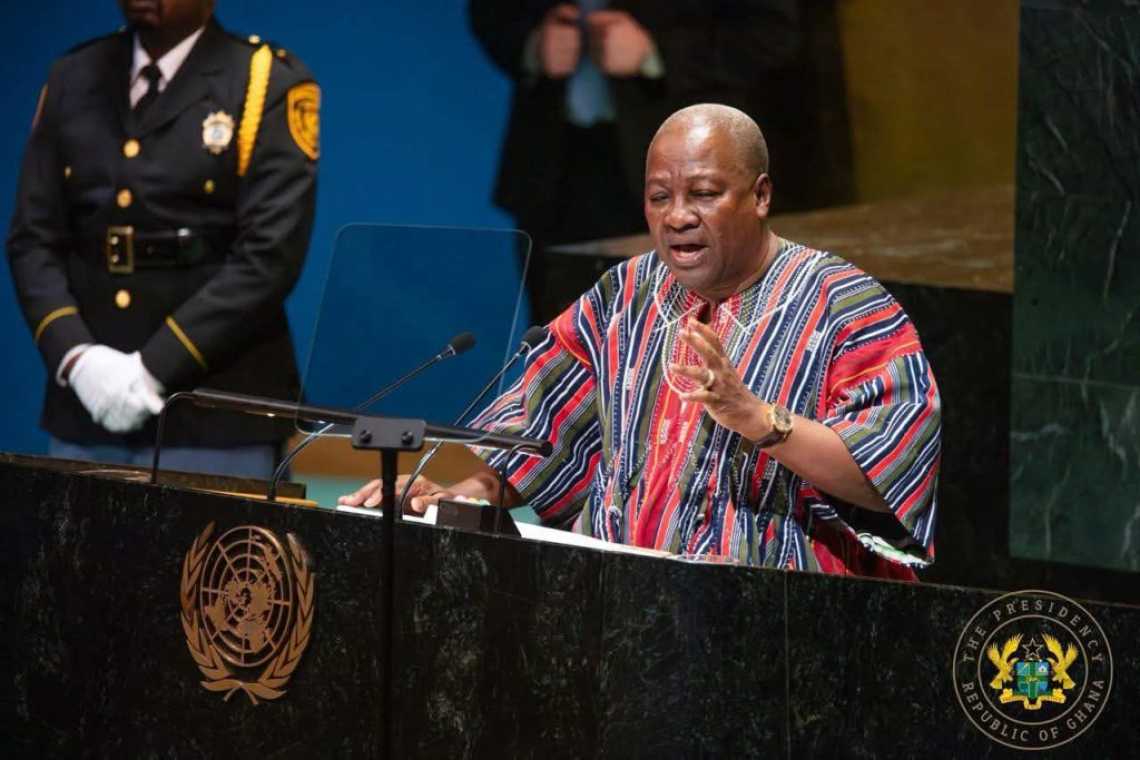
In what is being hailed as a "defining moment" for global justice, President John Dramani Mahama is set to lead a historic diplomatic charge at the United Nations General Assembly (UNGA). On March 25, 2026, Ghana will formally table a resolution to declare the transatlantic slave trade as the "gravest crime against humanity" in recorded history.
The move, spearheaded by Ghana in its capacity as the African Union (AU) Champion on Reparations, seeks to create the first comprehensive UN framework on slavery in the organization’s 80-year history.
1. Defining the "Gravest Crime"
The draft resolution, developed in collaboration with CARICOM and the African Union, argues that the trafficking of enslaved Africans was not merely a historical era of injustice, but a "definitive break" in world history.
The Four Pillars of the Resolution:
-
Scale & Duration: Acknowledging the 400-year span and millions of lives affected.
-
Systemic Brutality: Highlighting the "racialized chattel" nature of the enslavement.
-
Structural Imbalances: Linking historical slavery to modern-day debt asymmetries and global financial inequalities.
-
Enduring Consequences: Addressing the "development gaps" that persist between the Global North and South.
2. Beyond Symbolism: A Foundation for Reparations
Analysts emphasize that this resolution is designed to be functional, not just symbolic. By securing a formal UN declaration of "the gravest crime," the international community establishes a legal and moral baseline for reparatory justice.
Key Objectives of the 2026–2036 Decade of Action: | Objective | Action Plan | | :--- | :--- | | Accountability | Establishing a formal reckoning for nations and institutions that profited from enslavement. | | Reconciliation | Fostering "healing" through the acknowledgment of historical truths. | | Financial Reform | Addressing how the legacy of slavery manifests in today's climate vulnerability and debt crises. | | Heritage Preservation | Funding the protection of African heritage sites and burial grounds. |
3. The Global Coalition
The resolution is the result of a massive "South-South" diplomatic effort. Ghana’s Foreign Affairs Minister, Mr. Samuel Okudzeto Ablakwa, and Special Envoy Ekwow Spio-Garbrah have been coordinating with:
-
UNESCO: To ensure the educational and cultural aspects are preserved.
-
CELAC: Representing Latin American and Caribbean interests.
-
PALU (Pan African Lawyers Union): To provide the legal "teeth" for the resolution’s language.
4. A "Moral Test" for the World
The Ministry of Foreign Affairs has scheduled a series of high-level events leading up to the vote:
-
March 24: A solemn wreath-laying ceremony at the African Burial Ground in New York.
-
March 24 (Later): A High-Level Event on Reparatory Justice at the UN.
-
March 25: The formal tabling and debate in the General Assembly.
The Bottom Line
President Mahama’s resolution is a call for a "Global Reset." By asking UN Member States to be "on the right side of history," Ghana is challenging the world to move past mere apologies toward tangible accountability. As the AU Decade of Action on Reparations (2026–2036) begins, this vote will serve as the ultimate litmus test for the international community’s commitment to truth and equity.