
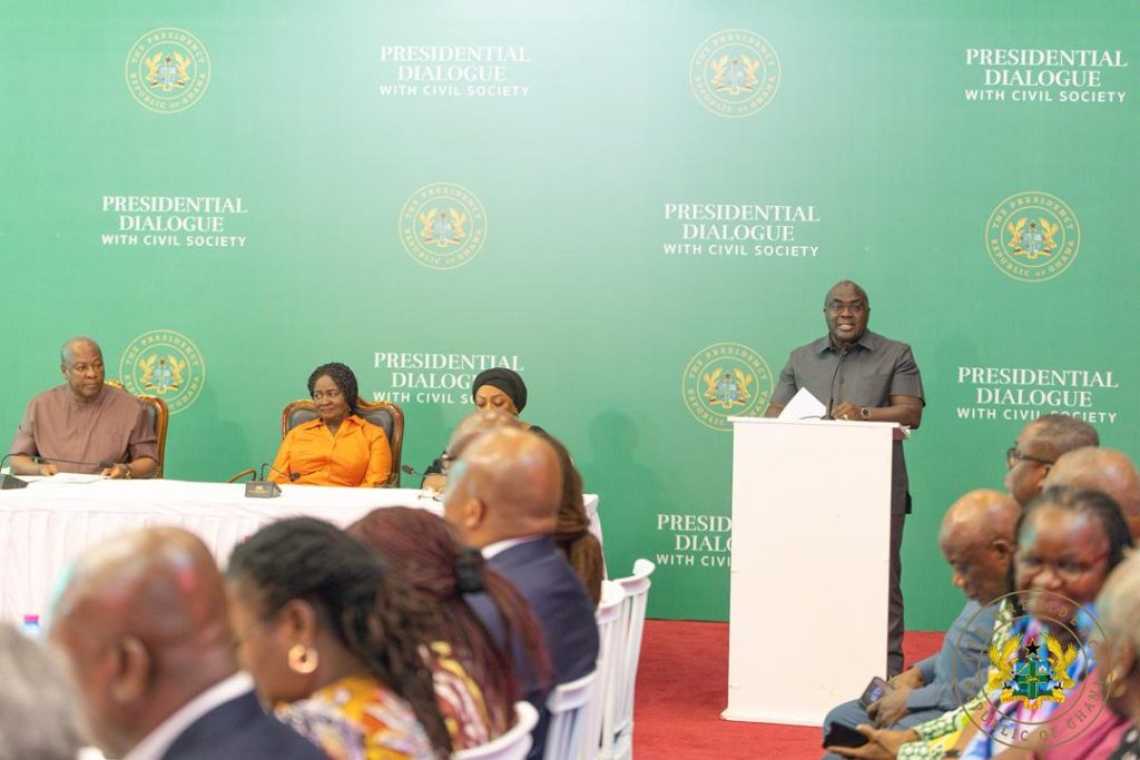
In a landmark Presidential Engagement at the Jubilee House, President John Dramani Mahama has formally recognized Civil Society Organizations (CSOs) as "indispensable partners" rather than adversaries in Ghana's development. This session, following similar dialogues with organized labor and the private sector,
signals a "Participatory Reset" aimed at embedding diverse citizen perspectives into the highest levels of policymaking.
A major highlight of the engagement was the President's announcement that the government is reviving the Constitutional Review process, a move intended to strengthen the nation's democratic checks and balances for the "2026 Era."
1. The Constitutional & Legislative Reset
President Mahama revealed that the government has completed its examination of the Constitutional Review Committee's recommendations. To move from dialogue to action, the Constitutional Review Implementation Committee (CRIC) will soon be established to oversee the next phase of reforms.
Key Legislative Pillars of Accountability:
-
Governance Advisory Bill: Creates a formal, permanent structure for continuous stakeholder input into government decisions.
-
Public Officers’ Code of Conduct Bill: Currently before Parliament, this bill defines clear ethical standards, addresses conflicts of interest, and regulates the use of public office.
-
Public Procurement Act Amendment: A strategic move to limit single sourcing and mandate transparency, particularly in the "Big Push" infrastructure projects.
2. Guarding the "Big Push": Transparency Measures
Addressing specific concerns regarding procurement under the Big Push program, the President confirmed that the government is actively obtaining full reports on alleged irregularities. He emphasized that media scrutiny and CSO criticism are "assets rather than obstacles" to good governance.
Institutional Safeguards:
-
Independent Value for Money Office: Being fast-tracked to provide non-partisan reviews of all large-scale state procurements.
-
Social Accountability: CSOs are officially encouraged to monitor public projects, oversee budget execution, and rebuild public trust in state institutions.
3. Social Sector Milestones: April 15 Launch
The President reiterated the upcoming April 15, 2026 launch of the Free Primary Healthcare Programme. This flagship social intervention aims to eliminate financial barriers at the community level, focusing heavily on preventive care.
The "24-Hour Economy" Synergy: | Policy | Target | Synergy with CSOs | | :--- | :--- | :--- | | 24-Hour Economy | Youth Job Creation & SME Support | CSOs to monitor labor standards and impact. | | Free Primary Healthcare | Community-level health access | CSOs to support public education and feedback. | | Ghana Medical Trust Fund | Specialized healthcare access | CSOs to provide research on healthcare equity. | | Apprenticeship Programmes | Vocational skill acquisition | CSOs to facilitate community-level training. |
4. Context: A Wednesday of National "Resets"
The Presidential-CSO dialogue is the cornerstone of a transformative week in Ghana:
-
Diplomacy: New Chinese Ambassador Cong Song pledged support for the Reset Agenda, coinciding with record $14.1B bilateral trade.
-
Fiscal: BoG Governor Dr. Johnson Asiama revealed record $13.8B reserves, aiming to drop lending rates below 20%.
-
Sports: A "Technical Reset" for the Black Stars following the departure of Otto Addo and the narrow 2-1 loss to Germany.
-
Human Rights: President Mahama’s commitment to "Human Dignity" following the UN resolution recognizing the slave trade as a grave crime against humanity.
The Bottom Line
President Mahama’s engagement represents a "Civil Space Reset." By institutionalizing dialogue through the Governance Advisory Bill and reviving the CRIC, the administration is attempting to move beyond "tokenistic" consultation toward a model of governance where the "sacrificial sweat" of civil society directly informs the laws of the land. As the April 15 healthcare launch approaches, the partnership between the state and the "watchdogs" will face its first major implementation test.