
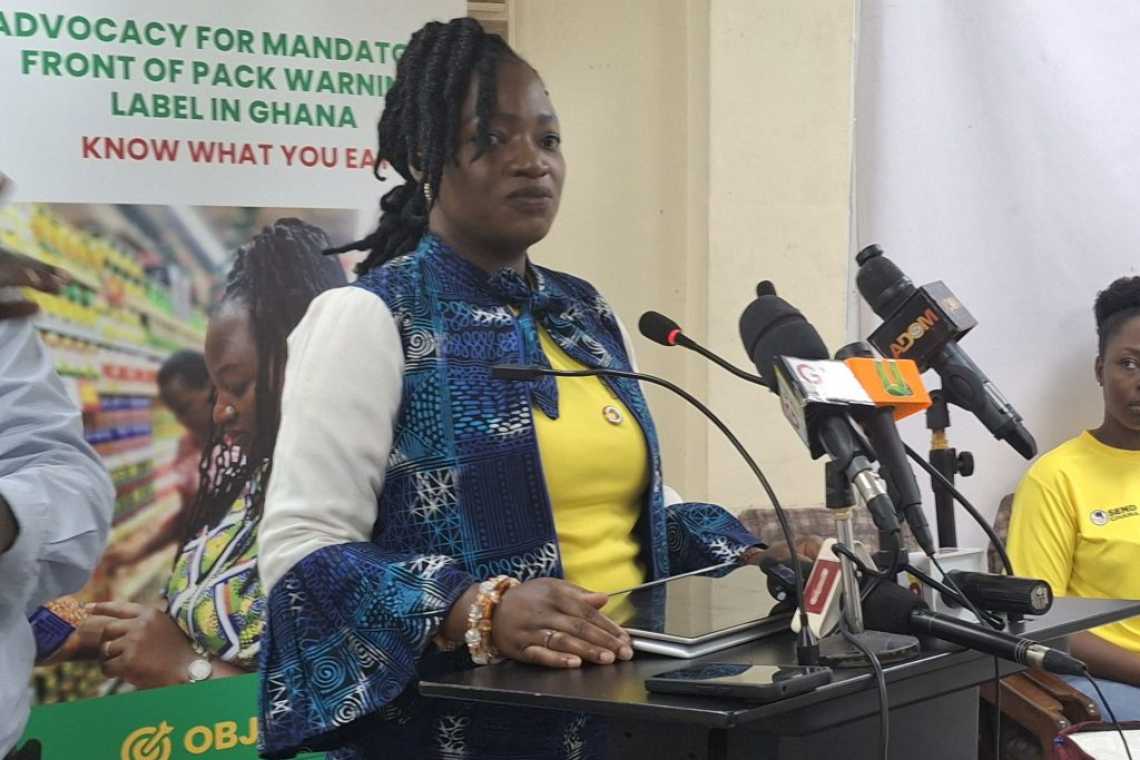
In a major push for public health transparency, a powerful coalition led by SEND Ghana, the Ghana Academy of Nutrition and Dietetics (GAND), and Vision for Accelerated Sustainable Development (VASD) has called on the Government to immediately fast-track the Front-of-Pack Warning Food Labelling (FOPWL) policy.
The move comes as Ghana grapples with an alarming surge in Non-Communicable Diseases (NCDs), which now account for approximately 45% of all deaths in the country. Advocates argue that without clear, visible warnings on ultra-processed foods, the "silent killer" of chronic kidney disease will continue to overwhelm the national health system.
1. The Kidney Crisis by the Numbers
Project Lead at SEND Ghana, Ms. Levlyn Konadu Aseidu, highlighted the staggering pressure on the health sector, citing figures from Health Minister Mr. Kwabena Mintah Akandoh.
-
National Burden: More than 4 million Ghanaians are currently living with chronic kidney disease.
-
New Cases: Approximately 400 new cases of end-stage kidney failure are recorded annually at health facilities.
-
The Financial Gap: While the Ghana Medical Trust Fund (MahamaCares) was launched to provide a financial safety net for specialist treatments like dialysis and cardiovascular surgery, advocates insist that prevention is the only sustainable solution.
2. Why "Back-of-Pack" Labels are Failing Consumers
Currently, nutritional information in Ghana is largely confined to technical panels on the back of products, often printed in small fonts. The proposed FOPWL policy aims to replace confusion with clarity.
The "Warning Label" Standard: | Current System (Back-of-Pack) | Proposed System (Front-of-Pack) | | :--- | :--- | | Technical language (e.g., "Sodium per 100g") | Simple symbols (e.g., "High in Salt") | | Small, hard-to-read font | Large, visible icons on the front of the pack | | Requires mathematical calculation | Provides instant "Stop & Think" signals | | Often hidden by packaging folds | Positioned at the primary point of purchase |
3. Targeting the "Ultra-Processed" Environment
Prof. Kingsley Pereko, Immediate Past President of GAND, warned that Ghana’s food environment is increasingly dominated by ultra-processed goods that target children and busy professionals.
Primary "Nutrients of Concern":
-
Instant Noodles & Chips: Often exceed recommended daily salt intake in a single serving.
-
Energy & Sugary Drinks: Marketed to youth but containing excessive sugar levels linked to obesity and diabetes.
-
Biscuits & Processed Snacks: High in unhealthy fats and low in essential nutrients.
4. Lessons from the Continent
Ghana is not alone in this fight. The coalition pointed to successful regulatory frameworks elsewhere:
-
Chile & Mexico: Have seen a measurable reduction in the consumption of unhealthy snacks since implementing warning labels.
-
South Africa: Currently leads the continent in implementation.
-
Nigeria & Kenya: Actively developing similar regulatory frameworks to protect their populations.
The Bottom Line
The call for the FOPWL policy is a "Public Health Reset." By moving from complex data to clear warning symbols, the government can empower 33 million Ghanaians to make informed choices before they reach the checkout counter. As Ms. Aseidu noted, for a policy to be effective, it must be visible. The ball is now in the court of the Ministry of Health to move from "initiation" to "implementation."