
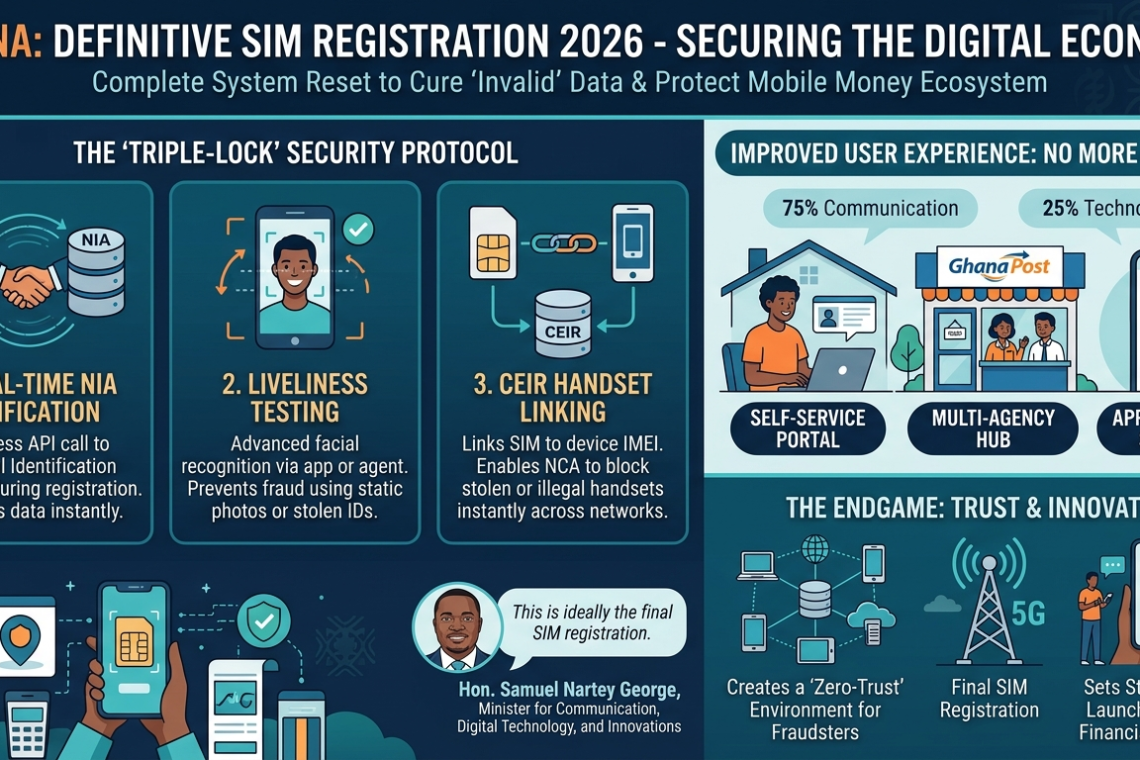
The Minister for Communication, Digital Technology, and Innovations, Hon. Samuel Nartey George, has announced that Ghana is moving toward its definitive SIM registration exercise. Aimed at curing the "invalid" data collected in previous years, the 2026 initiative is a complete system reset designed to secure the nation’s multi-billion cedi mobile money ecosystem.
The "Triple-Lock" Security Protocol
Unlike previous attempts, the 2026 registration introduces a three-layered authentication stack to ensure that every SIM is tethered to a living, verified human being:
-
Real-Time NIA Verification: Unlike the offline "batch" processing of the past, telcos must now perform a seamless, real-time API call to the National Identification Authority (NIA) database during registration.
-
Liveliness Testing: Using advanced facial recognition, subscribers must pass a "liveliness test" via a smartphone app or agent portal. This prevents the use of photocopied or stolen ID cards.
-
CEIR Handset Linking: For the first time, the Central Equipment Identity Register (CEIR) will link the SIM card to the specific IMEI number of the mobile device, allowing the NCA to block stolen or illegal handsets across all networks instantly.
User Experience: No More Queues?
The 2026 strategy is "75% communication and 25% technology." To avoid the infamous queues of 2022, the government has authorized:
-
Self-Service Portals: Subscribers can register from home using dedicated apps.
-
Multi-Agency Hubs: Ghana Post offices and Community Information Centres will serve as registration points.
-
Appointment Systems: For those requiring in-person assistance, an online booking system will manage foot traffic.
The Endgame: Trust in the Digital Economy
By cleaning up the 20% of the database that previously failed verification, the government aims to create a "zero-trust" environment for fraudsters. As Minister Sam George noted, this is ideally the "final SIM registration," setting the stage for the launch of 5G technology and deeper financial inclusion.